Science Unit 3 — Study Guide
Energy and Matter in Organisms · 5th Grade · River Ridge / Frilot
All 20 practice-test questions with the correct answer highlighted.
Unit 3 Pretest
1 What is the process plants use to make their own food?
- sunlight
- chlorophyll
- photosynthesis ✔
- carbon dioxide
💡 Plants use sunlight, water, and carbon dioxide to make food. That process is photosynthesis.
2 What is a habitat?
- all the animals living in the ocean
- the space where a plant or animal lives ✔
- all of one kind of animal or plant in the same area
- living and nonliving things that interact in the same space
💡 Compare: an ecosystem is living and nonliving things that interact in the same space.
3 All living things need certain things to live and grow. Which of these do ALL living things need to survive?
- blood
- energy ✔
- sunlight
- carbon dioxide
💡 Every living thing needs energy to live and grow (not all need sunlight or blood).
4 In a grassland food chain, grasshoppers eat grass. Then meerkats eat grasshoppers. What is the main role of the grasshopper in this food chain?
- make a new habitat
- be a source of energy ✔
- clear grass for space to live
- lay eggs to make more grasshoppers
💡 The grasshopper eats grass and is eaten by the meerkat, so it passes energy along.
5 This picture shows a prairie food chain. How does the owl get energy?
- by eating mice ✔
- by eating grass
- by eating other owls
- by eating grasshoppers
💡 Follow the arrows: the mouse is right before the owl.
6 Which organism is a producer?
- a bush ✔
- a wolf
- a horse
- a grasshopper
💡 A producer makes its own food. A bush is a plant; wolves, horses, and grasshoppers are consumers.
7 What makes up an ecosystem?
- all the animals living in a rain forest
- the space where a plant or animal lives
- all of one kind of animal or plant in the same area
- living and nonliving things that interact in the same space ✔
💡 Compare: a habitat is the space where a plant or animal lives.
8 Mr. Sullivan drew this picture on the board. The tree takes in carbon dioxide and gives off oxygen. What is the name of the process shown in the picture?
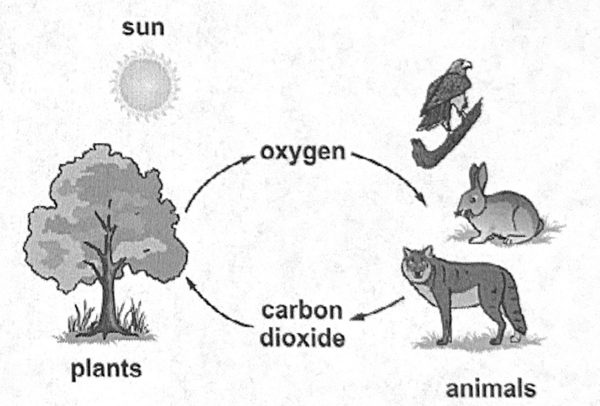
- food chain
- producing
- decomposing
- photosynthesis ✔
💡 The tree uses carbon dioxide and gives off oxygen while making food — photosynthesis.
Lesson 1: Plants & Energy
9 What can plants do that animals cannot do?
- Plants can grow and change.
- Plants can move to find food.
- Plants can make their own food. ✔
- Plants can use air to help them survive.
💡 Plants are producers: they make their own food. Animals must eat.
10 A student set up an investigation with four plants of the same kind. Plant 1 gets light and water. Plant 2 gets light but no water. Plant 3 gets water but no light. Plant 4 gets no water and no light. What will happen to the plants?
- Plant 1 will grow well. ✔
- All plants will grow well.
- Plants 1 and 3 will grow well.
- Plants 2 and 4 will grow well.
💡 Plants need both light and water. Only Plant 1 gets both.
11 Gail puts a green plant in a closed wooden box. She gives it good soil and plenty of water. What will happen to the plant?
- It will die because living things need oxygen.
- It will die because it does not get any sunlight. ✔
- It will grow slowly because it also needs plant food.
- It will grow fast because it has good soil and water.
💡 Plants need sunlight to make food. A closed box blocks the light.
12 Russ puts four bean plants on a windowsill and waters them daily: plant A – 0 mL, plant B – 10 mL, plant C – 25 mL, plant D – 50 mL. He measures the height of each plant every week. Which best describes how much water young bean plants need every day?
| Height of Plant | ||||
|---|---|---|---|---|
| A | B | C | D | |
| Start | 5 cm | 5 cm | 5 cm | 5 cm |
| Week 1 | 5 cm | 11 cm | 15 cm | 13 cm |
| Week 2 | 3 cm | 15 cm | 22 cm | 18 cm |
| Week 3 | 3 cm | 18 cm | 27 cm | 22 cm |
- 0 mL
- 10 mL
- 25 mL ✔
- 50 mL
💡 Plant C (25 mL) grew the tallest: 5 → 15 → 22 → 27 cm.
Lesson 2: Matter & Energy
13 This picture shows a food chain that can be found in a prairie. How is the plant different from the snake?
- The plant is a consumer and the snake is a producer.
- The plant is an herbivore and the snake is a carnivore.
- The plant is a producer and the snake is a consumer. ✔
- The plant is a carnivore and the snake is an herbivore.
💡 Plants make their own food (producers). Snakes eat other animals (consumers).
14 A food chain, like this one, shows how energy moves between living things. Which living thing best completes the partial food chain?
- bird
- plant ✔
- carnivore
- herbivore
💡 Food chains start with a producer. The rabbit eats plants.
15 How are decomposers like consumers?
- They provide energy to producers.
- They must capture prey in order to survive.
- They can make their own energy from sunlight.
- They get their energy from producers or other consumers. ✔
💡 Decomposers and consumers both get energy from producers or other consumers.
16 What do all animals need for growth?
- oxygen, water, and food ✔
- oxygen, sunlight, and food
- carbon dioxide, food, and water
- carbon dioxide, nutrients, and sunlight
💡 Animals need oxygen, water, and food to grow.
Lesson 3: Organisms Interact
17 Earthworms live in soil. They eat rotting leaves and the remains of dead insects. Wastes from earthworms add nutrients to the soil. Earthworms are food for some birds. Which statement best describes the niche of an earthworm?
- Earthworms live in soil.
- Soil contains nutrients for plants.
- Earthworms use remains of insects found in soil as food. ✔
- Rotting plants and remains of insects can be found in soil.
💡 A niche is an organism's role — what it does and eats in its environment.
18 The picture shows a food web. Which organisms does the penguin compete with?
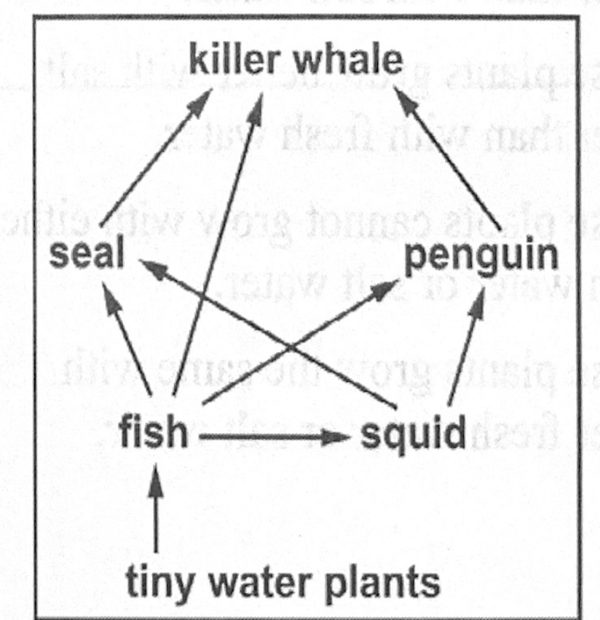
- fish and seals
- fish and squid
- killer whales and squid ✔
- tiny water plants and seals
💡 The penguin eats fish and squid. Killer whales and squid also eat fish, so they compete for food.
19 Tina does an experiment with two plants. She gives plant 1 fresh water. She gives plant 2 salt water. The picture shows the results of Tina's experiment. What can you infer?
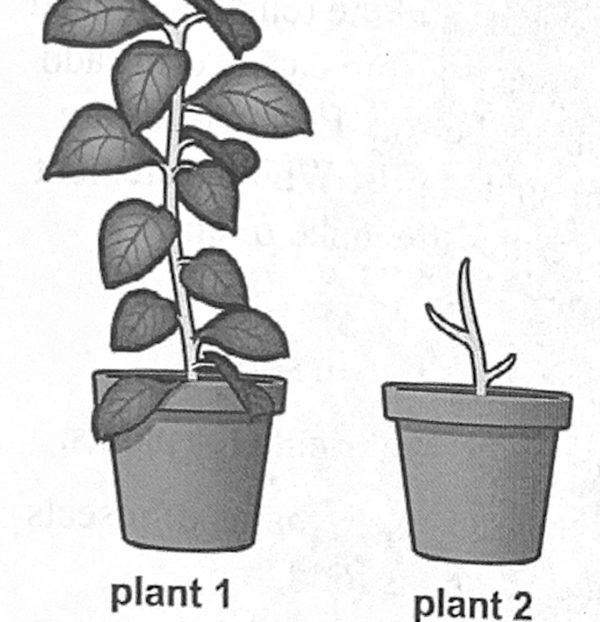
- These plants grow better with fresh water than with salt water. ✔
- These plants grow better with salt water than with fresh water.
- These plants cannot grow with either fresh water or salt water.
- These plants grow the same with either fresh water or salt water.
💡 Plant 1 (fresh water) grew tall; plant 2 (salt water) dried up.
20 This picture shows the life cycle of a frog. Which statement describes the environment the frog needs throughout its life?
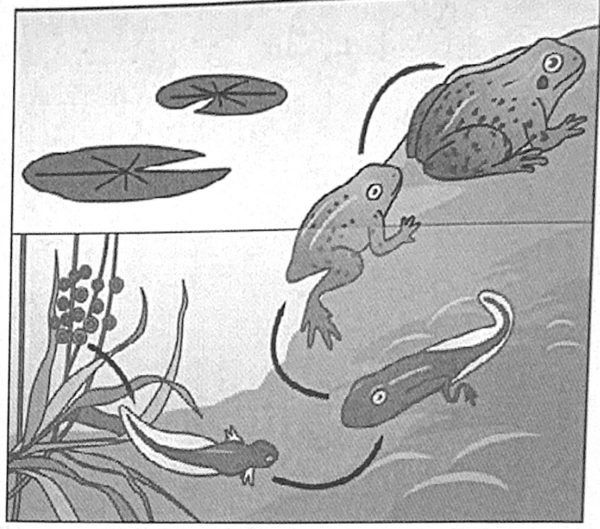
- A frog lives on land all its life.
- A frog lives in water all its life.
- A frog hatches on land, and lives in water when it is an adult.
- A frog hatches in the water, and lives on land when it is an adult. ✔
💡 Eggs and tadpoles live in the water; the adult frog moves onto land.